Happy New Year!
Sorry it's been a while...

I guess I’ve been negligent in my sci-fi substacking duties. Apologies, dear, tiny cadre of friends.
I’ll try to be better about this in the future. I guess I should’ve come by to weigh in on recent sci-fi landmarks like Stranger Things and Avatar. But, eh, I find I don’t have much to say about either. I did make TikTok’s about both, so if you’re really curious: Stranger Things finale and Avatar 3.
I did finish a science fiction novel a while back and it turns out I wrote a big thing about it and never published it, so I might as well share that with you now:
Version Control
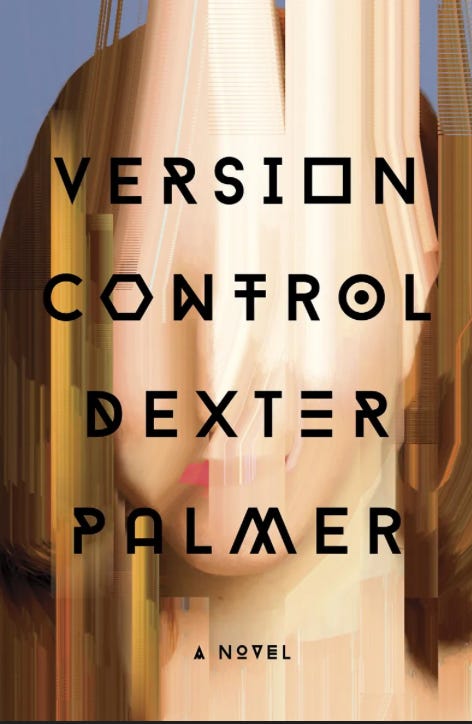
I can’t quite pin down the thesis of Version Control. I also don’t think it’s possible to talk about it without spoiling things within the novel. I haven’t read the book blurb or the back cover or any reviews—so I’m not sure how much of the story, its themes and structures, is revealed in that ancillary material. For my part, as I often do, I went in blind. I’m sure when I added to my queue in my Libby library app that whoever (probably a TikTok video) recommended it gave some indication of what it was about, but blessed are the forgetful and whatever clues once flitted through my mind and motivated me to read it are now gone.
That, it turns out, is pretty ironic.
So by way of spoiler-free review, I will only say that not much happens in this novel for a long, long time. We simply follow along in the lives of a few interconnected characters—one woman and her family and friends—for quite some time without any real driving conflict or any sense of what this novel will, ultimately, turn out to be about.
There are definitely hints of its eventual nature. These characters inhabit a near future that doesn’t quite look like our own. An AI avatar of the president is omnipresent, introducing every television program and often making individualized statements to citizens through their devices that reveal a garrulous surveillance state. But the characters’ lives are just ordinary lives. Precocious children. Stagnating marriage. Office—well, laboratory—politics.
But at the center of it all is the Causality Violation Device, a long-running experiment that its designer, our protagonist’s husband, does not want you to call a time machine.
But you know, of course, that when he says that, it must be a time machine. And by the Chekov’s gun principle, you know that it must be used at some point.
Beyond that, though, it’s difficult to discuss without giving too much away. The prose reminded me of Tomorrow, Tomorrow, and Tomorrow. Perhaps a little fluffier, but it had that same workmanlike thoroughness in its attention, if not all of that novel’s verve. The story, and this borders on too much, so turn away if you want to too much revealed, made me think of Dark Matter without the melodrama.
Version Control’s theory of time travel is clear enough by the ending—really, turn away now if you don’t want to know—and it presents a pretty unique wrinkle in this staid and well travelled science fiction genre. If you go into the Causality Violation Device, you can come out in the past, at the point at which a wormhole was anchored to our reality. But you must return. (Vaguely, the universe will ensure you do, literally moving your atoms back into the machine and back into the present/future you left.) You can change the past, change history, change everything.
You will not know it, though.
You—your body, your memories, everything—will be changed, too. This is reminiscent of some of the nonsense in the movie Looper, but at least here it has greater logical consistency and has the good sense to be instantaneous from the point of view of the future, or really from the point of view of the reader since the future never knows anything has been changed. There is a glaring flaw in this, though, in that one character, the inventor’s son, apparently is subconsciously aware of the many, branching historical realities and his parents’ roles in them, giving him an otherworldly awareness that is even more magical than atoms being rearranged based on whether or not they ever belonged to a particular human body.
Basically, as sci-fi tropey-ness goes, I’d put it somewhere just above Time Cop starring Jean Claude Van Damme.
What I can’t pin down, though, is what author Dexter Palmer wants us to believe about history and causality from all this. There’s a Panglossian sheen to a lot of the theories tossed about by characters who are, to varying and always limited degrees, aware of the operation of the Causality Violation Device. The philosophical undercurrent seems to be that we can only act on our imperfect knowledge of the world around us and the cause-and-effect we can see and understand, but that’s somewhat undermined as a central theme when the characters’ meddling in time gives their son superpowers.
And its implications about the inconstancy of identity seem sloppy as well. Characters take different roads in different realities, typical multiversal fare, sure, but it seems beneath the waterline for what this book is aspiring to. One character in particular feels obnoxiously under served. Alicia, a hard-nosed physicist who works in the lab central to the story is portrayed as both brilliant and arrogant. She rubs the other women in the story the wrong way, but is seen to have carved herself space in a male-dominated field. But then we see her go from bed to bed in the different realities, cheapening her supposed integrity by turning her into alternately an unlikely seductress and then consolation spouse. Another couple plays out the same exact bizarre break up scene in two different directions. Once it seems to suit the character ending things, but the second time it feels gratuitous.
What I found most compelling in all of this was the satire that Palmer works in about life in the Information Age, most of which comes via the main character’s connection to and eventual employment by Lovability, a dating website. His take down of the cynical reduction of human beings to data points as the ultimate expression of corporate culture’s inhumanity was brilliantly worded, even if it smacked of contrived monologuing. But its connection to the rest of the novel’s thematic territory feels tenuous at best.
I wanted to unpack all of this before I went and read what others have written about it. I feel like this is one of those novels/stories that some people will find very profound and intricate, but that feels pasted together to me. Let me see…
And when I went and looked around, I didn’t find a lot written about this book. I did find some acolytes who really admire it, but nothing that revised my basic assessment that it’s clever, but not revelatory. In a way, it reminds me of One Battle After Another—not in the content or anything, but just because it feels like the tension between the satire and the earnestness of its conceit creates too much friction for me.
I suppose that’s all for now, but I’ll try to be better about visiting with my takes on all things sci-fi in the future (in case anyone cares but also just because I think it’s good for my memory to write about the things I read).
I’m also starting a new writing series on my website. I’m starting to journal (what might be) my last year as a teacher leading up to my (still potential) retirement next year. We’ll see how long I keep it up, but for what it’s worth, I’m going to put my first little memoir chapter up now.