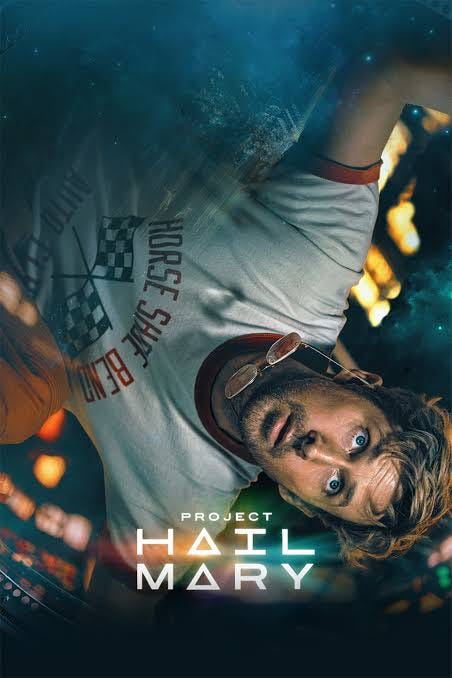
Project Hail Mary
Holy moly, am'I right?

In case you didn’t hear about it, Andy Weir, author of the Martian and Project Hail Mary, recently said some pretty dumb stuff.
He started by trashing all of recent Star Trek. (In fairness, he apologized for this part later.) Apparently, he’d made a Star Trek pitch some years ago that wasn’t accepted and, honestly, it sounds like we all dodged a bullet there because he said in the interview that he wishes Star Trek would drop all the preachy stuff and just give us more space battles.
He went on to say that he didn’t think art and literature had to be all political and stuff. His books, he asserted, were not at all.
It’s the kind of stuff podcast bros say when they’re trying to avoid admitting to voting for Trump.
If it surprises you then…well, no, it’s pretty surprisingly dense from somebody who usually comes off as a smart guy. But people often have different ranges of intelligence and, honestly, when you look at his work, Andy Weir’s oeuvre is pretty limited. Let’s examine his track record:
With its story of a stranded astronaut using scrappy ingenuity and the scientific method to survive alone on Mars, the Martian was a big hit. (A self-published to mainstream success, which anyone who knows me knows I’m always championing. Hell, I’ll find a few nice things to say about Coleen Hoover for this reason.) He followed it up with Artemis, a more classically sci-fi novel set on a teeming moon colony. Now, I haven’t read this one, but the consensus seems to be that it, um, wasn’t as successful. I’ve heard critiques that really blasted Weir and suggested that portraying the underworld-adjacent female narrator of the book was beyond his powers.
So he returned to form with Project Hail Mary, back to a scrappy, quippy protagonist stranded alone in space.
Or was he!
The big twist, and one that really enriched the story, was that Ryland Grace, the hero of Project Hail Mary, was not alone. As anyone who’s seen the movie trailers can now tell you, he meets an alien. The other twist—SPOILERS for both book and movie from here on out—was that Grace was an unwitting astronaut who’d been pressed into the Earth-saving mission against his will. These additional layers make Hail Mary a bit more fun and a bit more compelling than the Martian, if less grounded.
Listen, I frequently recommend these books as entry points into the broader genre for people who haven’t really read sci-fi. They are light, engaging and fun reads, but works of deep literature, they really are not. Andy Weir has proven, thus far, that he’s really good at doing this one thing: having a plucky narrator “science the shit” out of problems.
I think it’s safe to say, then, that the movie Project Hail Mary is one of those examples of a film adaptation surpassing its (already great) source material. The book is a fun read, but it is not one of the greatest science fiction novels of all time, okay? The movie, though, is an absolute triumph of storytelling and filmmaking.
A perfect movie.
The core story is obviously pretty similar. It is a very faithful adaptation in which Weir was deeply involved. But Drew Goddard’s screenplay (he also wrote the screenplay for the Martian) tightens up the narrative with several nips and tucks.
He wisely corrects the absolute worst moment in the book. During the big reveal that Grace was a coward who had to be forced onto the mission, the other main (human) character Stratt tells Grace that she’s going to give him some Handwavium to suppress his memory so he won’t be bitter when he wakes up in deep space.
That’s as deeply stupid as Weir’s comments on the podcast.
Why would you want to do ANYTHING to the memory of the scientist you’re sending on this civilization-saving mission to deep space!?! Better for him to wake up bitter in Tau Ceti. It’s not like he can quit or file a protest with HR.
The movie wisely just makes Grace’s amnesia an unintended and unavoidable side effect of the stasis process (only described as an induced comma in the film).
But minor continuity improvements like that are only one of the ways the film transcends the novel. I don’t think I was especially aware of Lord and Miller as directors before this film. If you’d asked me ahead of time if I thought the guys who did 21 Jump Street and The Lego Movie had any chance of producing a sci-fi adaptation on par with Ridley Scott’s The Martian, then I think I might have expressed some skepticism. But they steer this ship with a capable, um, with capable hands, making some great calls that give it a really fantastic texture. Famously now, the film uses no green screen and has minimal digital effects (mostly to remove the wire and ring harness that allowed star Ryan Gosling to appear to float in zero G). Even the other main character, five-legged alien Rocky, is a practical effect. The space shots are sumptuous, framing both the isolation, peril, and wonder of deep space with haunting planetary vistas and awe-inspiring infrared shots of the alien phenomenon threatening Earth’s survival.
It’s a beautiful film.
But a huge amount of credit has to be given to the film’s star—and not just because he was a driving force in bringing this story to the screen. His performance is often zany and comic, but Gosling’s range allows him to infuse key moments with incredible emotional weight. It’s been a few years since I read the book, but I don’t remember ever feeling the kind of pathos in the pages that he brings to the critical emotional junctures for the character.
I was talking the other day about serious sci-fi and pulp sci-fi and how it was possible to bridge the gap between them. This film does exactly that: taking a fun and engaging novel and turning it into a truly moving story of comradeship and self-discovery.
It’s a triumph of cinema and instantly one of the greatest science fiction films of all time.
So go see it if you haven’t already! I’ve gone twice, but my wife won’t come with me a third time (even though she, too, loved it). Presently I’m waiting for the nearly four-hour extended cut that will air on Amazon Prime. I really doubt it will be a superior version of the film, but you never know.
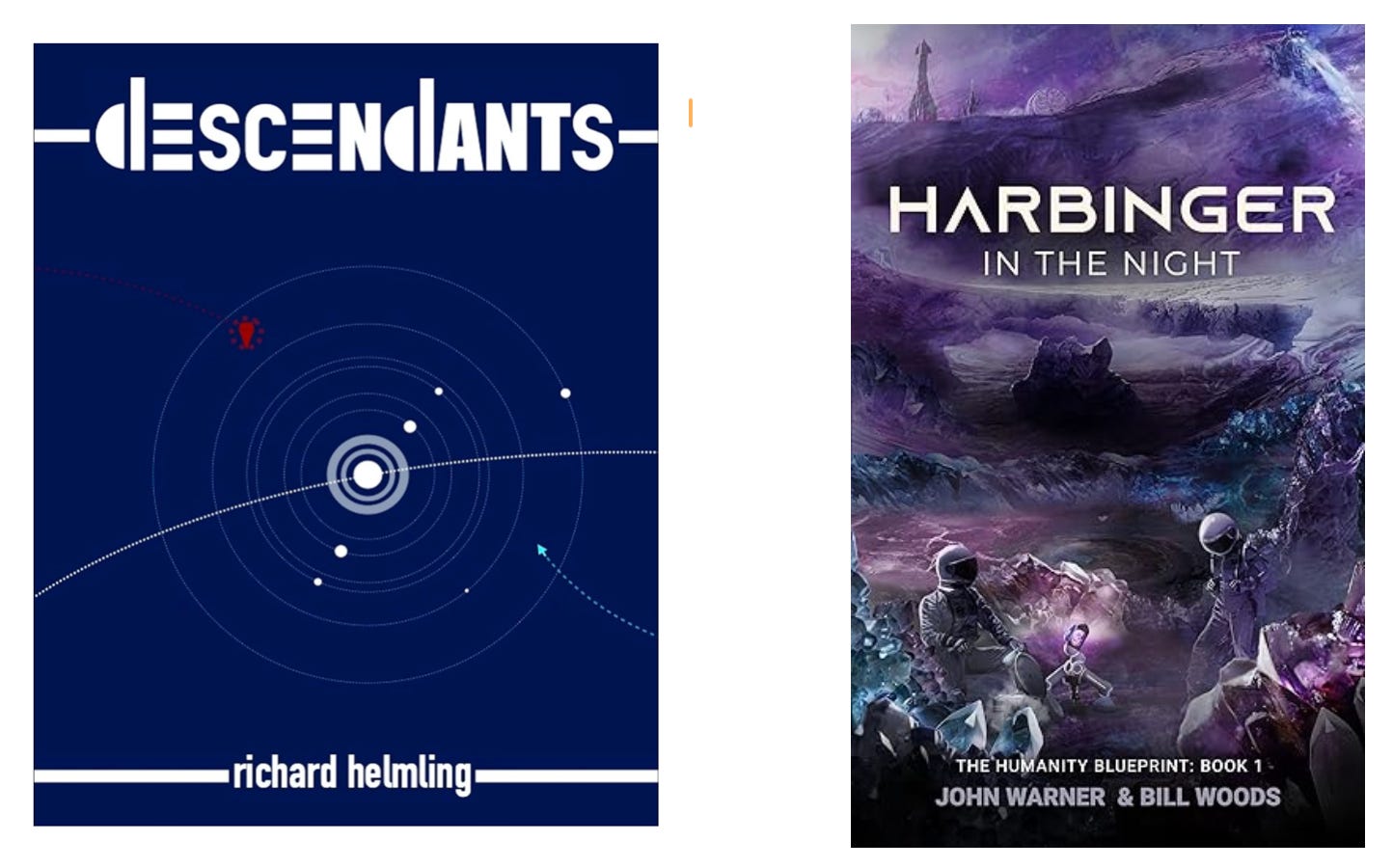
And if you want more first contact stories, then check out my book Descendants or my buddy John’s book.